Regional Zero-Fare Transit Study
The Wasatch Front Regional Council (WFRC), the Mountainland Association of Governments (MAG), the Utah Department of Transportation (UDOT), and the Utah Transit Authority (UTA) jointly conducted a study to evaluate the potential effects of partially or fully eliminating fares on the UTA system. The study was a data-informed, technical process intended to provide decision makers with information regarding the financial, operational, and community-related trade-offs of four different alternatives to partially or fully eliminating transit fares.
In February 2022, UTA instituted “Free Fare February” to improve air quality and celebrate the 20-year anniversary of the Salt Lake Olympics. Ridership increased significantly across all transit modes. Data from this program was used to inform the zero-fare transit study.
Study Goals
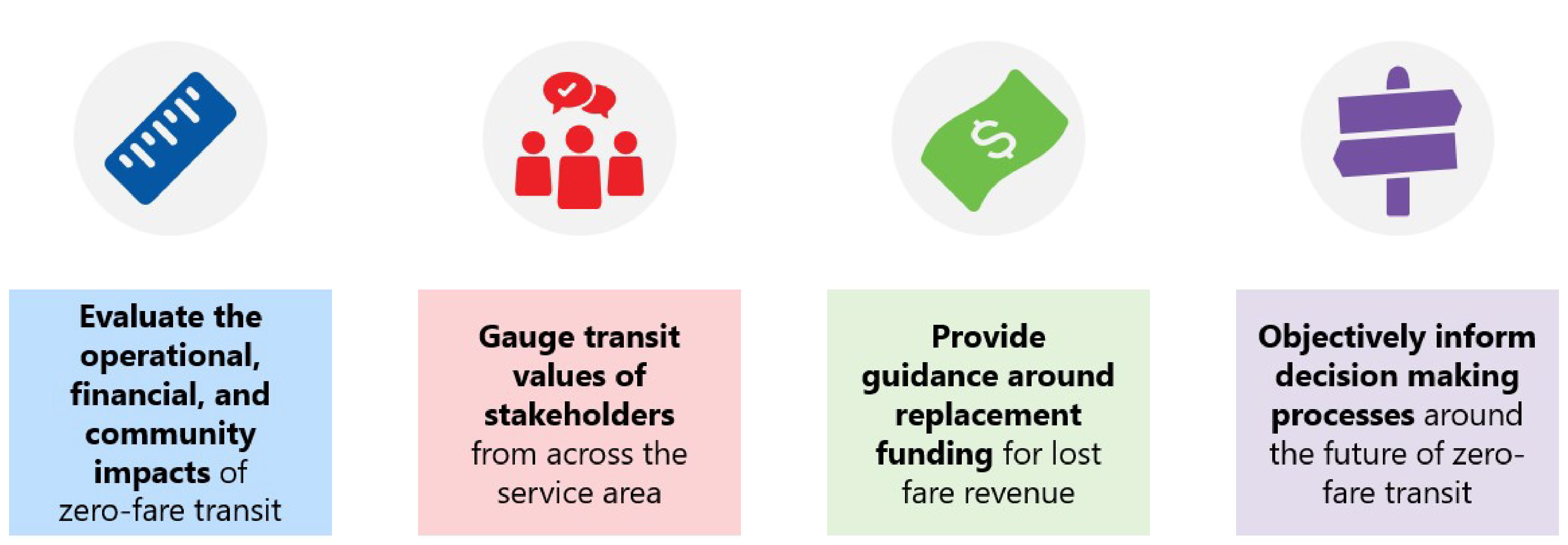
The transportation agencies established goals to guide the study process. These goals included evaluating the impacts of a zero-fare transit system, engaging stakeholders to gather input, creating guidance regarding replacement revenue options, and providing objective information for decision makers to consider.
Four different alternatives were evaluated by costs and benefits. The analysis was organized into three main categories: operational efficiency, financial health, and community benefits. Operational efficiency metrics included service provision and performance. Financial health metrics included the relative costs and revenue considerations. Community benefits metrics included social equity and economic opportunity.
Study Alternatives & Findings
Systemwide Zero-Fare
Elimination of fare collection on UTA bus, TRAX, FrontRunner, and Paratransit services
The systemwide zero-fare alternative has the potential to increase ridership by up to 36%, address social equity goals, and has a measurable impact on I-15 congestion and vehicle emissions.

Zero-Fare on Bus
Elimination of fare collection on UTA bus and UTA On-Demand only
Zero-fare on bus service has the potential to increase ridership by up to 18%. It also addresses social equity goals but does not have as much of an impact on traffic congestion or vehicle emissions as most bus trips are shorter and non-freeway based.

Zero-Fare for Low-Income Riders
Elimination of fares for eligible low-income riders
Zero-fare for low-income riders has the potential to increase ridership by up to 8%. It would somewhat help to address social equity but has a minimal impact on traffic congestion and vehicle emissions.

Lower Fares on All Services
Reduce base fare to $1, reduce other fares and pass costs by 60%
$1 fares on all services has the potential to increase ridership by up to 10%. This alternative less directly aligns with social equity goals because the financial barrier of paying a fare at the point of service remains in place. This scenario would also have a minimal impact on traffic congestion and vehicle emissions.
Contact
For additional information, please contact:

Julie Bjornstad
Long-Range Planning Deputy Director